Black cats are the hardest subject to put on a small pendant and the best subject for a silhouette. Both of those things are true at once, and knowing which one you are buying is the difference between a piece that looks striking and a piece that looks like a smudge.
Every October the market fills with black cat pendants, most of them generic. This guide is about the parts that survive past November: which styles actually render a black cat well, what the symbolism does and does not carry, and the two dates in the year that are worth planning around.
AI Summary
Overview
Photo-print pendants struggle with solid black fur. Detail disappears into a dark shape unless the source photo has strong side or rim light.
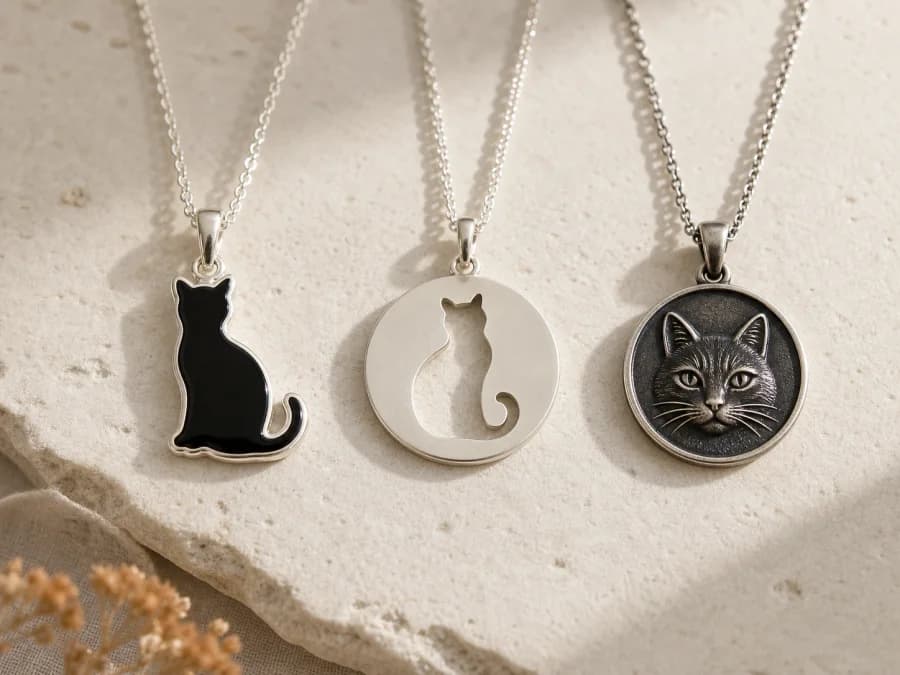
Silhouette, negative-space cutout, and black enamel are where black cats look best, because the design uses the darkness instead of fighting it.
Give the eyes something to do. A tiny green or gold accent reads as a cat far more reliably than fine fur detail at that scale.
Black coatings wear at edges and high points. That is normal for black PVD and black rhodium, and worth expecting rather than disputing.
Two dates: August 17 in the US and October 27 in the UK. Both are adoption-awareness observances, not shopping holidays, which makes them good gift anchors.
Why Black Cats Are Hard to Render
Photographers know this already: black fur absorbs light, so detail collapses. On a pendant the problem compounds, because you have also shrunk the whole subject to about the size of a thumbnail.
What that means in practice:
- A printed photo of a black cat under resin often comes back reading as a dark oval. The cat is technically there. It does not look like anything at a glance.
- Engraved line work on a black cat has to be invented rather than traced, because the source photo has no visible internal edges to follow.
- Ear shape, whisker line, and eye placement carry almost the entire likeness. Coat pattern contributes nothing.
If your cat is solid black, the winning move is to stop chasing photographic detail and choose a design that uses the shape. Silhouette, outline, and enamel all lean into that.
The one case where a printed photo does work: a source image with hard side light or backlight, so there is a bright rim along the cat's back and ears, and a clear catchlight in the eyes. If you have that shot, a print keeps it. If you have a flat indoor snapshot, an engraving or silhouette will read better at pendant scale.
Styles That Work
| Style | Why it suits a black cat | What to check before ordering |
|---|---|---|
| Silhouette or profile cutout | The whole design is shape, so black is an asset | Ask whether the outline is your cat's or a stock shape |
| Black enamel on silver or gold | Glossy black against bright metal gives contrast the fur cannot | Kiln enamel is more color-stable than resin fill; ask which |
| Oxidized sterling silver | Darkened recesses with polished high points reads as depth | High points brighten with wear, which is the intended look |
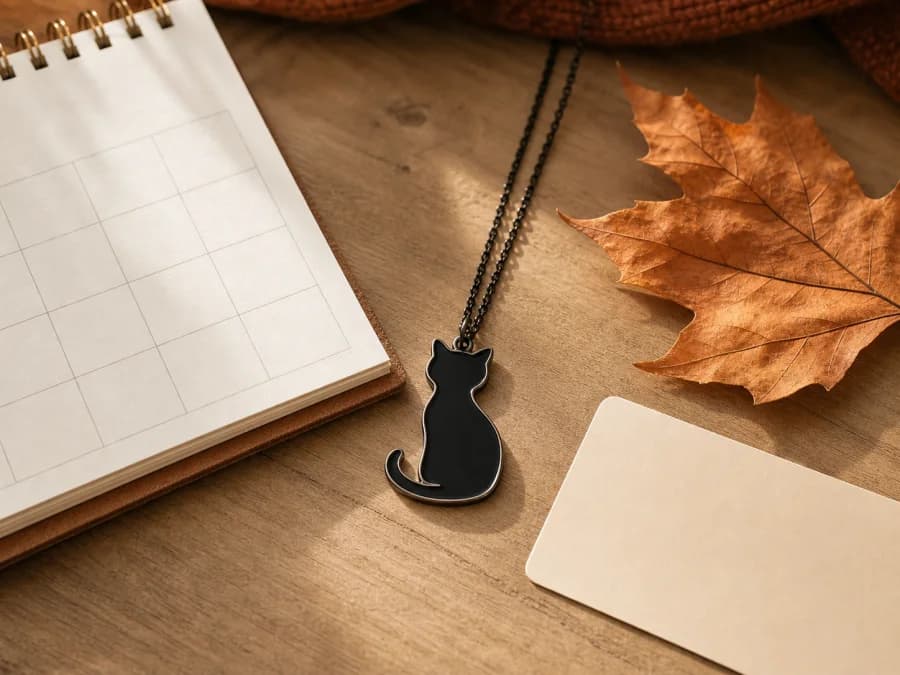
| Black PVD or IP coating on steel | Uniform matte or satin black, durable for daily wear | Coating wears at edges over time; not permanent |
| Negative-space cutout | The cat is the hole, so light does the work | Thin sections can be fragile; ask about metal thickness |
| Onyx or obsidian inset | Genuine black stone, deeper than paint | Confirm natural stone versus dyed or glass |
| Line engraving with an eye accent | Cheapest route to a readable likeness | Ask for the line-art proof before production |
The most reliable custom option for a specific black cat is a clean line or silhouette portrait, engraved or cut, with one small colored accent for the eyes. It is also the cheapest to get right, because the proof is a drawing you can approve or reject in five seconds.
Metal Pairings
Black gives you unusual freedom here, because it goes with everything. Some practical notes:
- Warm metals maximize contrast. Gold tone against black enamel is the highest-contrast combination and photographs well.
- Bright silver or steel gives a cooler, graphic look that suits geometric and minimal designs.
- Black-on-black — matte black coating with no bright metal — looks excellent and disappears completely against dark clothing. Consider where it will actually be worn.
- Black coatings are coatings. Black PVD, IP plating, and black rhodium all wear at friction points. A seller promising a black finish that never changes is making the same claim as a seller promising gold plating that never fades, and it is no more accurate. The material comparison behind that is in photo necklace materials compared.
If you want a black cat piece with genuinely no coating to wear off, the options are enamel fused to metal, natural black stone, or oxidized silver — where the darkness is chemistry in the surface rather than a layer on top of it.
What the Symbolism Actually Carries
Black cat folklore is not one tradition, it is several contradictory ones, and which one a recipient has in mind matters more than any "true" meaning.
- In parts of Western Europe and North America, black cats picked up associations with witchcraft and bad luck that trace to medieval superstition. That is the version most Halloween imagery draws on.
- In Britain, a black cat crossing your path has often been read as good luck, and black cats were considered lucky for sailors and their families.
- In Japan, black cats have long-standing positive associations, including with warding off misfortune.
- In modern rescue and adoption culture, a black cat is frequently a statement about adoption itself — the cat nobody else picked.
None of this is fact about cats. It is fact about people. Practically, that means:
- If you are buying for someone who adopted a black cat deliberately, the adoption-advocacy register usually lands best.
- If you are buying for someone who leans into the witchy, gothic, or Halloween aesthetic, that is a completely different design language, and it is fun rather than superstitious.
- Do not assume a recipient finds bad-luck imagery charming. Some do, some find it tiresome.
Gift Timing
| Occasion | Timing | Notes |
|---|---|---|
| Black Cat Appreciation Day (US) | August 17 | Quiet, low-competition date; good for a custom piece with a proof step |
| National Black Cat Day (UK) | October 27 | Cats Protection campaign; high social visibility |
| Black Cat Awareness Month / Halloween season | October | Huge novelty supply, mostly generic; custom work needs to be ordered earlier |
| Adoption anniversary | Whenever theirs is | The strongest personal anchor for a specific-cat pendant |
| Birthdays and December holidays | Usual rush | Order well ahead; custom proofs and revisions eat the calendar |
The October trap is worth naming. Between late September and Halloween you can buy a black cat pendant in about nine seconds, and it will be a generic shape in an unnamed alloy. If you want something kept, order the specific-cat version early enough that the proof step is not a panic. The ordering mechanics are in the custom cat photo necklace buyer's guide, and the broader gift logic — metal tone, chain length, what to confirm before ordering — is in cat mom and cat dad gift ideas.
Choosing the Source Image
Even a silhouette needs a good starting photo. What helps most with a black cat:
- Side light or backlight, so there is a bright edge along the back, ears, and whiskers
- A visible catchlight in at least one eye
- A profile or three-quarter angle, which makes ear and muzzle shape readable
- A plain background lighter than the cat
- No heavy filters, which flatten the little contrast you have
What to avoid: dim indoor light, a dark couch or dark floor behind the cat, and a straight-on face shot with no shadow definition. Those produce the dark-oval result.
If you only have flat photos, say so when you order and ask for a silhouette or line treatment instead of a print. A good maker will tell you the same thing.
One Boundary
Black cat pendants are human-wear jewelry. If you want something for the cat to wear — an ID tag, a collar charm — that is a different product with different requirements around breakaway hardware, weight, and chewable materials, and a person's pendant does not meet them. Do not put a photo pendant on a cat's collar.
NookPetdia does not sell custom cat photo jewelry yet, and there is deliberately no cart button here. When the first human-wear pieces exist, including options that suit solid black cats, they will appear in the custom cat photo jewelry collection. If you are still deciding between a pendant and a framed portrait, jewelry versus a print covers that tradeoff.
References
National Black Cat Day (Cats Protection)
The history of National Black Cat Day (Cats Protection)
National Black Cat Day, October 27 (National Day Calendar)
Resin vs enamel jewelry (AJ Luxe)
Titanium vs stainless steel jewelry for everyday wear (Grisé NYC)
Editorial synthesis of private owner-discussion research on custom pendant likeness and finish durability, reviewed 2026-07-29. Folklore notes describe cultural beliefs, not claims about cats.
Animal Behavior & Care Writer
Rachel has a background in zoology and animal care volunteering. She writes about cat behavior, enrichment, and the relationship between cats and their everyday environment.
Written by Rachel Breen. Read our Editorial Policy.
FAQ
Frequently asked questions
New on NookPetdia
Latest articles
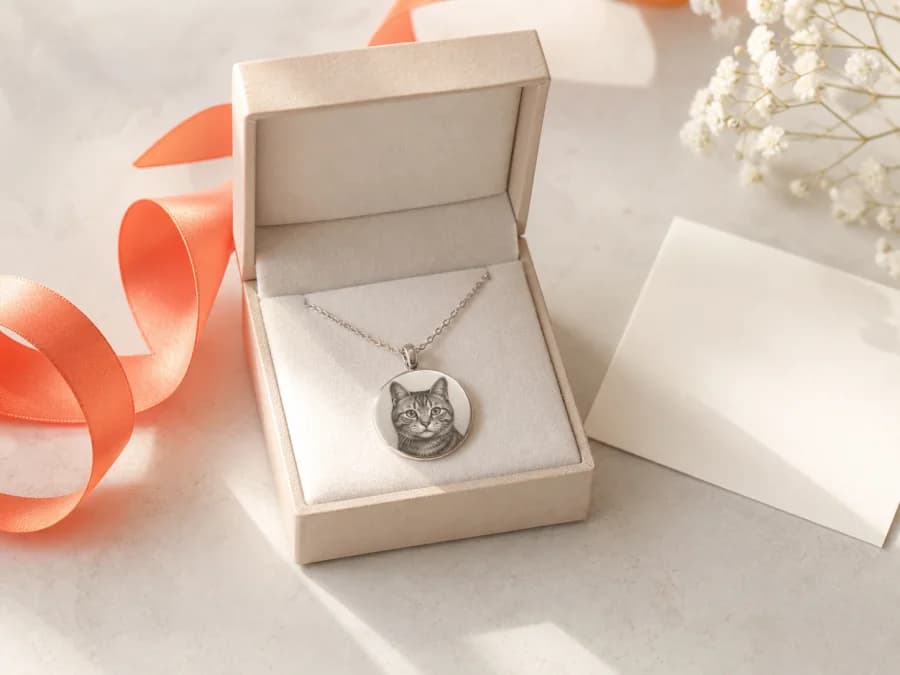
Cat Mom & Cat Dad Gift Ideas That Aren't Cheap Charms
Most cat-themed gifts are novelty items that get used twice. Here is how to buy something a cat parent keeps — including what to confirm about metal, sizing, and timing before you order anything personalized.
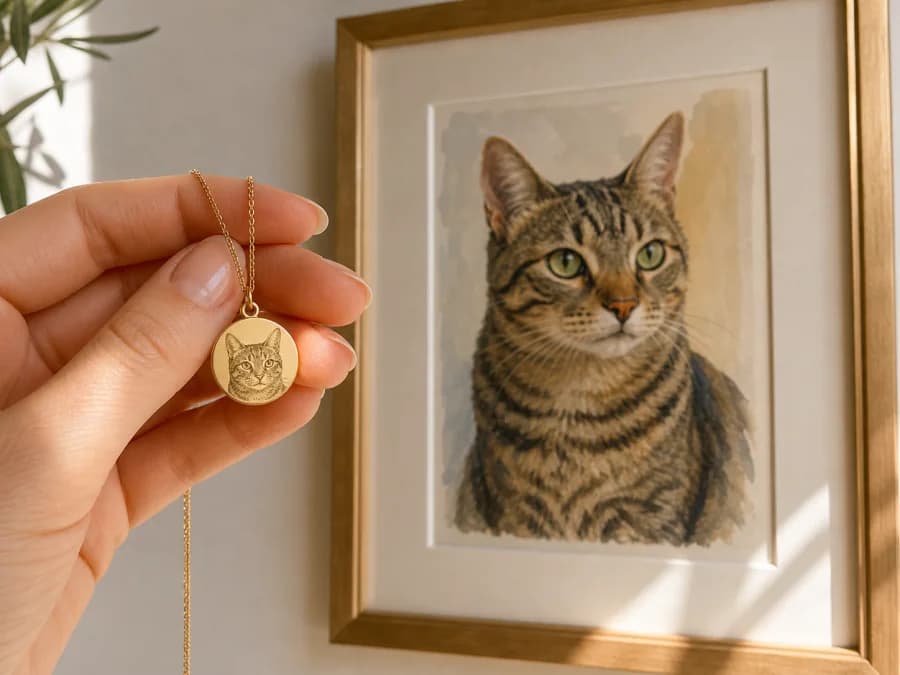
Custom Pet Portrait Jewelry vs Print: What's Worth Buying
Wearable portrait jewelry and framed pet portraits solve different problems. Here is how they compare on likeness, cost, durability, and daily use — and which one to commission first.
Photo Necklace Materials Compared: Silver, Gold-Plated, Stainless
A practical comparison of the metals used in custom photo pendants — sterling silver, gold plated and vermeil, 316L stainless, and titanium — plus what actually causes fading, green skin, and irritation.