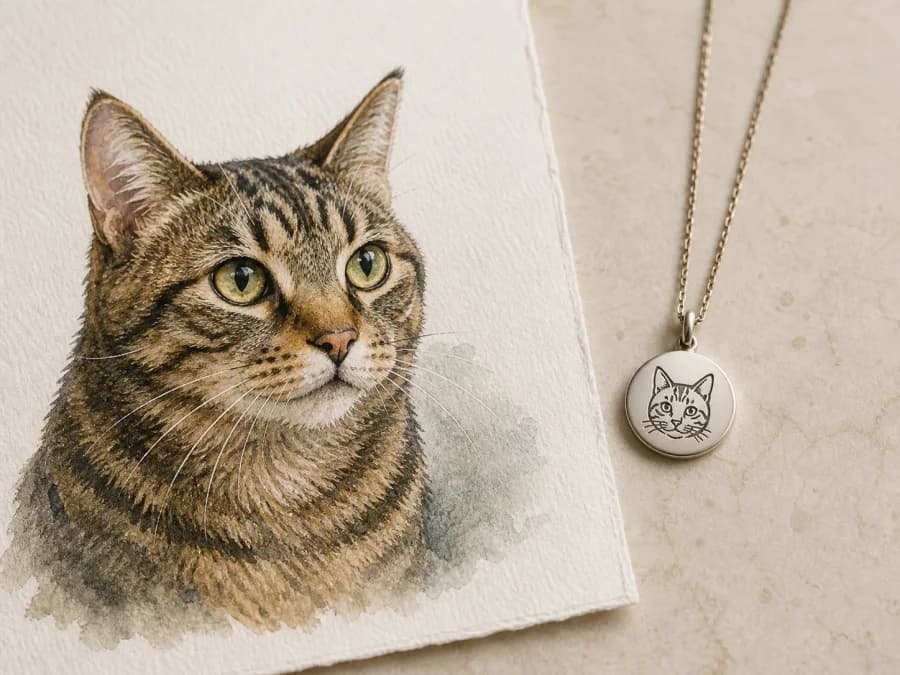
Most people searching for a custom cat portrait have not decided what form they want it in. They have decided they want their cat rendered by a human, or at least by something better than a phone screenshot. Then they hit a fork: a pendant you wear, or a portrait you hang.
They are not competing versions of the same purchase. A pendant is a small object that goes everywhere with you. A print is a large object that stays in one room and gets seen by everyone who enters it. Choosing badly is how you end up with a beautiful commission in a closet.
AI Summary
Overview
Jewelry wins on daily presence and portability; a print wins on size, detail, and visible impact in a room.
Prints hold far more likeness detail, because there is more surface. Small pendants simplify by necessity.
Cost per year of use usually favors jewelry, if you actually wear it. It favors prints if you do not.
Failure modes differ: prints fade in direct sun and need framing; pendants scratch, and plated finishes wear.
If you cannot decide, commission the artwork once and reuse it. A clean line or vector portrait can become both.
The Honest Comparison
| Dimension | Wearable portrait jewelry | Framed print or canvas |
|---|---|---|
| How often you see it | Every day you wear it, at arm's length | Every day you are in that room |
| Detail it can hold | Head and shoulders, simplified; fine striping and whiskers get lost | Full body, coat texture, background, multiple pets |
| Who else sees it | People close enough to notice, and only if they look | Everyone who visits, immediately |
| Typical spend | Low for plated or steel, higher for cast silver | Low for a paper print, higher for large canvas or hand-painted |
| Ongoing cost | Occasional polishing or eventual replating | Framing, and reframing if you move |
| Space needed | None | Wall space you control |
| Main way it ages badly | Plating wear, scratched resin over the image | Fading in direct sunlight, warping in humidity |
| Travels with you | Yes | Not really |
| Renter-friendly | Completely | Depends on your walls and lease |
| Best emotional register | Private, personal, close | Shared, declarative, decorative |
Where Jewelry Genuinely Wins
A pendant gets used, and a print gets looked past. That sounds like a slogan but it is the practical difference. People describe reaching for a pet pendant on hard days, on flights, in waiting rooms — the moments when a framed picture at home is not available.
Jewelry also fits situations a print cannot:
- Small apartments and shared housing where wall space is contested
- Renters who cannot or will not hang heavy frames
- Gifting to someone whose decor taste you do not know
- Anyone who wants the reference to be private rather than announced to visitors
And the cost math is friendlier than it looks. A modest stainless or plated pendant worn most days for two years is inexpensive per wear. A large canvas that ends up leaning behind a bookshelf is not.
Where a Print Genuinely Wins
Detail is the honest answer. A pendant is roughly thumbnail-sized. A print is not.
If your cat's appeal is in something intricate — dense tabby swirls, a long floofy coat, mismatched eyes, an absurd sitting posture, or the specific chaos of three cats together — a print keeps all of it. A pendant will keep the head shape, the ear set, and maybe one bold marking.
Prints are also better when:
- You want more than one pet in a single piece
- You want a background, a room, or a scene included
- You want an artist's actual style to be the point
- You are marking something that deserves to be visible to guests, like a home you just moved into
- You want the option of a large statement piece rather than a subtle one
There is also a plain aesthetic argument. Illustration reads well at size. Metal reads well as a symbol. Choosing which register you want is more useful than comparing prices.
The Move Most People Miss
Commission the artwork as a separate step from the object.
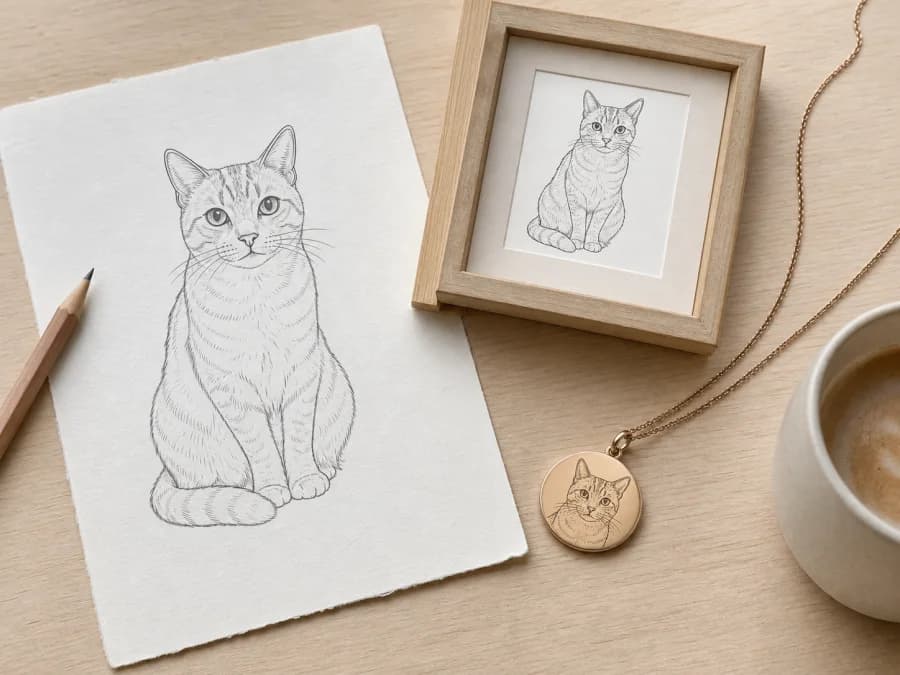
If you pay an illustrator for a clean portrait — ideally delivered as vector or high-resolution line art alongside the finished piece — that file can be sent to an engraver later, printed at a second size, or used for a card. If you buy a pendant from a shop that keeps its internal artwork, you own the pendant and nothing else.
Worth agreeing before you pay:
- Do you receive the source file, and in what format?
- Are you allowed to have it reproduced elsewhere for personal use?
- Is there a clean line-art or silhouette version, not just the rendered painting?
This also solves the likeness problem in the right order. You approve the drawing while it is still cheap to change, then commit it to metal or paper.
Fidelity: What Each Format Loses
| Feature | Print keeps | Pendant keeps |
|---|---|---|
| Coat pattern and fine striping | Yes | Bold markings only |
| Eye color | Yes | Only with enamel or printed image |
| Whiskers | Yes | Partially, and rarely in shallow etching |
| Full body and posture | Yes | Head and shoulders is typical |
| Multiple cats | Yes | Difficult and usually crowded |
| Background or scene | Yes | No |
If a specific detail is the whole reason you want the portrait, check that column before you order. "I wanted her nose freckles and you can barely see them" is a common and entirely predictable disappointment on a small pendant.
Durability, Realistically
Neither is permanent, and they fail differently.
Prints fade. Direct sunlight is the main culprit, and pigment inks, paper, and canvas all have limits. Glazing with UV protection helps, humidity does not, and a print stored rolled in a tube for two years often needs flattening before it can be framed.
Jewelry wears. Plated finishes rub through at friction points, resin over a printed image can scratch or yellow with age, and enamel can chip on impact. Unplated stainless, titanium, or solid silver with engraved detail is the most stable choice, which is why it comes up so often in photo necklace materials compared.
Cost of repair is worth noting too. A silver pendant can usually be polished or repaired by a jeweler. A faded print is replaced, not restored — though if you kept the source file, replacing it is cheap.
Decision Shortcuts
- You want it with you all day: jewelry.
- You want everyone who visits to see your cat: print.
- Your cat's markings are the whole point: print, or a printed-image pendant rather than an engraving.
- You are gifting and unsure of taste: a small, simple pendant in a metal you can name, or a print in a neutral frame.
- You have a strict budget and want the strongest first purchase: commission the drawing, get a modest print now, add the pendant later from the same artwork.
- You move often or rent: jewelry, and skip the framing question entirely.
- You want an heirloom object: cast silver with engraved or enameled detail.
A Note on What Not to Do
Do not repurpose a human-wear photo pendant as something for your cat to wear. It comes up because the pendant is small and the cat is right there, but jewelry made for a person's chain has none of the safety features pet-wear needs: breakaway hardware, weight suited to the cat, and materials that are fine to chew and clean. That is a separate product category, and a human pendant does not qualify.
If you are ordering either format for the first time, the process side — proofs, revision rounds, remake rules — is where most bad outcomes happen. That is covered in the custom cat photo necklace buyer's guide, and gift-specific traps are in cat mom and cat dad gift ideas.
NookPetdia's human-wear pieces are still in development, and there is no cart button here yet. Launch details will appear on the custom cat photo jewelry collection page.
References
Custom pet photo necklace review (Reviewed)
Photo necklace buying guide (FaithHeart)
Resin vs enamel jewelry (AJ Luxe)
Sterling silver vs stainless steel (AJ Luxe)
Editorial synthesis of private owner-discussion research on custom pet portrait commissions, reviewed 2026-07-29. Owner reports are qualitative experience, not verified product testing.
Founder & Editor
Micky is the founder and editor of NookPetdia, sharing practical cat-care guidance and product-fit advice for everyday cat parents.
Written by Micky. Read our Editorial Policy.
FAQ
Frequently asked questions
New on NookPetdia
Latest articles
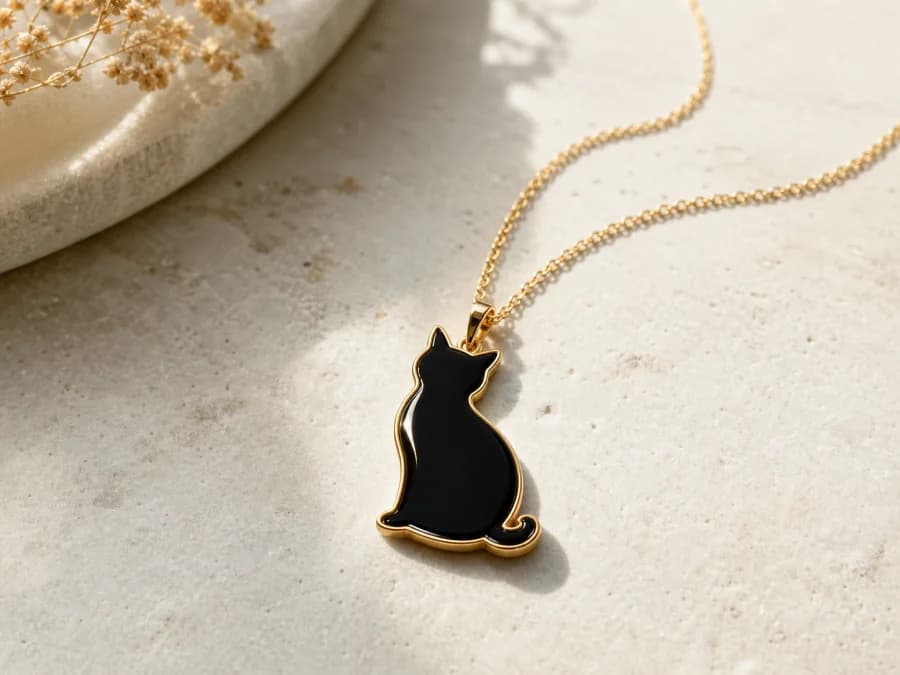
Black Cat Jewelry Guide (Style, Meaning, Gift Timing)
Black cats are the hardest subject to render in a small pendant and the best subject for silhouette work. Here is which styles hold up, what the symbolism actually carries, and the two dates worth planning a gift around.
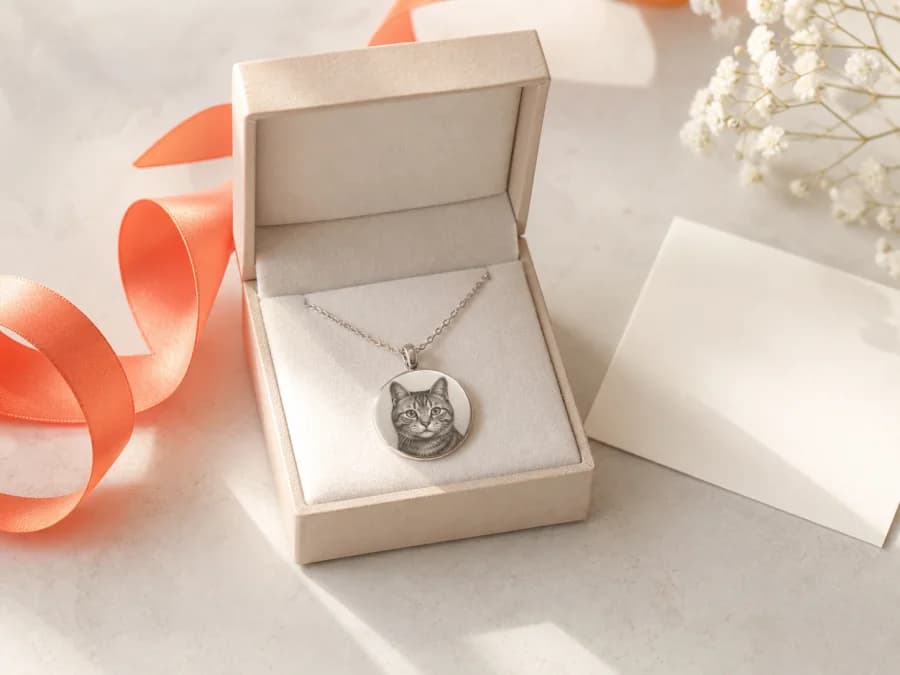
Cat Mom & Cat Dad Gift Ideas That Aren't Cheap Charms
Most cat-themed gifts are novelty items that get used twice. Here is how to buy something a cat parent keeps — including what to confirm about metal, sizing, and timing before you order anything personalized.
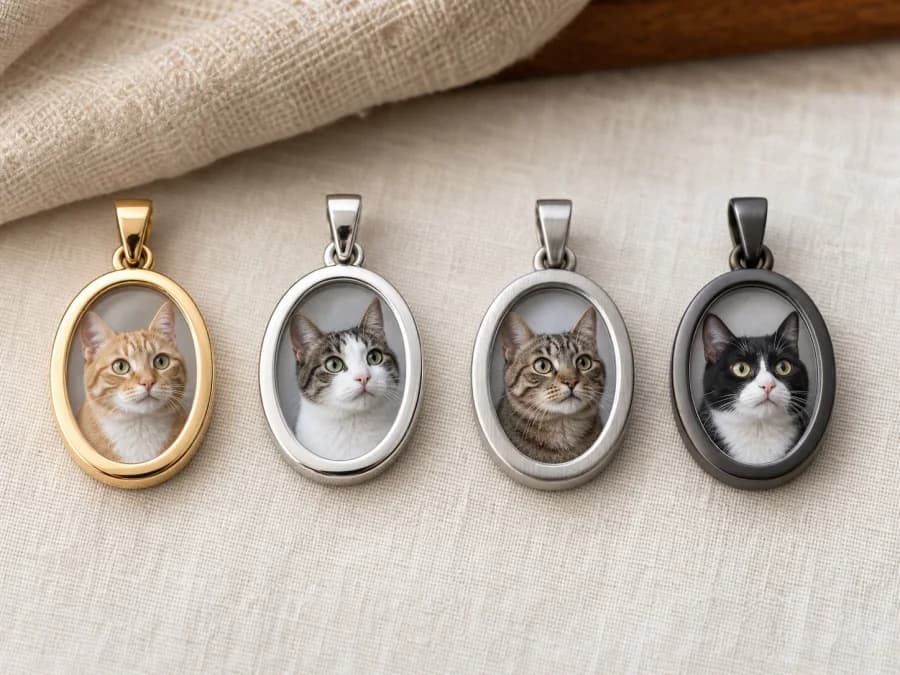
Photo Necklace Materials Compared: Silver, Gold-Plated, Stainless
A practical comparison of the metals used in custom photo pendants — sterling silver, gold plated and vermeil, 316L stainless, and titanium — plus what actually causes fading, green skin, and irritation.