A custom cat photo necklace is a piece of jewelry with your own cat on it, and it is worn by you, not by your cat. That distinction matters more than it sounds. Most of the frustration in this category comes from buyers who did not know what they were actually ordering: how the image gets onto metal, what the metal will look like in six months, and how much a small workshop can really promise about likeness.
We went through owner discussions about custom pet pendants, plus current jewelry-industry material guides, and the same handful of problems kept surfacing. None of them are exotic. All of them are avoidable if you ask a few specific questions before money changes hands.
AI Summary
Overview
A photo necklace is human-wear jewelry. Do not hang a photo pendant on a cat's collar; pet-wear tags are a separate product with separate safety rules.
Ask for a design proof or 3D render, approved by you, before anything is cut, cast, or engraved.
Treat "never fades" as a sales line. Plated finishes wear, and silver tarnishes. Both are normal.
Judge a shop by real production video and its own finished pieces, not by glossy customer photos that may be AI-generated or lifted from other makers.
Keep the order and the payment on the platform where you found the shop, so you still have recourse if the piece arrives wrong.
What You Are Actually Buying
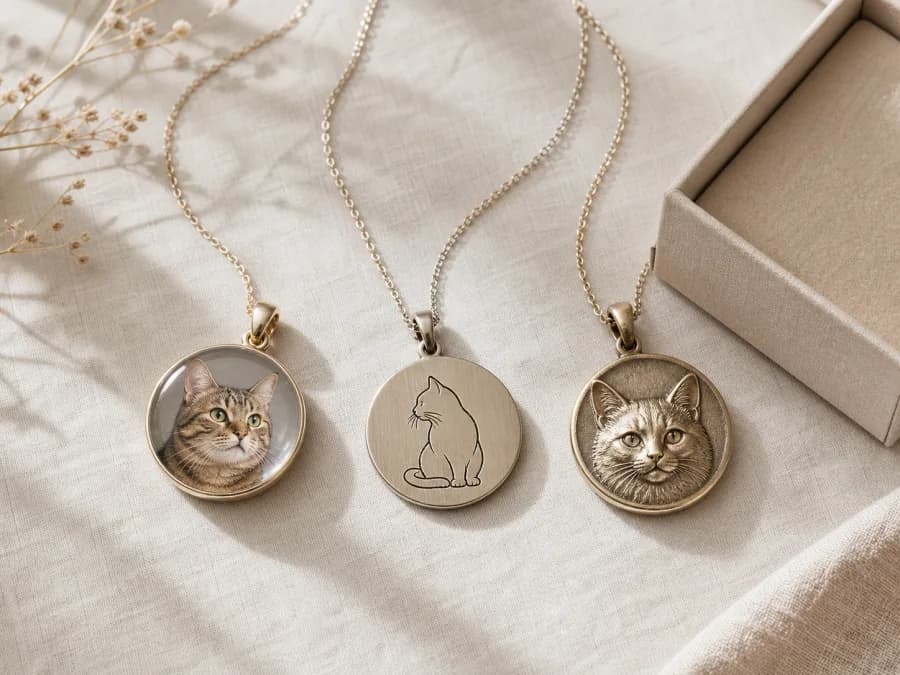
"Photo necklace" covers at least four different products, and they fail in different ways:
- Printed or sublimated image under resin. A flat printed portrait sealed under clear resin or glass in a metal bezel. Cheapest, most photo-accurate, most vulnerable to scratching and long-term yellowing of soft resin.
- Engraved or etched portrait. A laser or hand-etched line version of your cat directly in the metal. No image layer to yellow. Detail depends on how hard the metal is and how clean the source artwork is.
- Cast relief pendant. Your cat's face modeled in 3D, then cast in silver or another metal, sometimes with enamel color. Most expensive, most sculptural, longest lead time.
- Locket with a photo inside. Traditional locket, photo trimmed or sealed inside. The photo is protected but usually not visible while worn.
If a listing never says which of these you are getting, that is the first question to ask. The answer changes the price, the lead time, and the care instructions.
Pick the Photo First, Then the Shop
You do not need a studio session. You need one photo that already exists and already works. Before you shop, open your camera roll and look for:
- The cat's face turned toward the light, eyes clearly visible
- A background that does not blend into the fur
- Enough resolution that you can crop to just the head and shoulders without it going soft
- Distinguishing markings visible, not hidden in shadow
Owners who ended up disappointed often sent a busy, dim, or heavily filtered photo and then blamed the workshop. In owner discussions we reviewed, several makers said the same thing in different words: a cluttered image becomes a muddy engraving. A clean silhouette or profile with strong contrast survives the translation to metal far better than a cute-but-chaotic snapshot.
If your cat is solid black, contrast is the whole game. We cover that separately in the black cat jewelry guide.
The Design Proof Rule
This is the single change that prevents most bad outcomes: ask for a design proof before production starts, and put it in writing.
Depending on the product that proof might be:
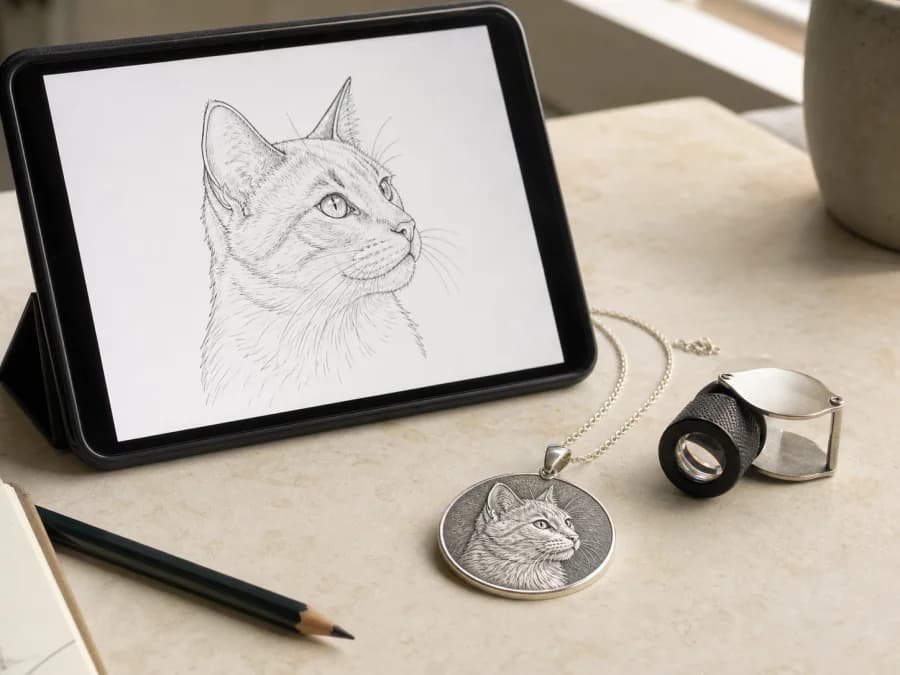
- A cleaned-up line drawing or vector for engraving
- A flat mockup showing crop, scale, and bezel placement
- A 3D render of the modeled pendant for cast pieces
One workshop's own process description, quoted in the discussions we reviewed, ran roughly: confirm the source photo has clear features, build the 3D model, get the buyer's approval on that model, then print the wax and cast the silver. That order is correct. If a shop wants full payment and then goes quiet for two weeks, the process is not the problem — the shop is.
Real complaints from that research: one buyer paid, waited more than two weeks, and received a rough cutout that had barely been separated from the background. Another said the finished piece did not match the technique that had been promised. Both would have been caught at the proof stage.
Reasonable expectations to agree on up front:
- When the proof arrives (a date, not "soon")
- How many revision rounds are included
- What happens if you reject the proof entirely — refund, or credit?
- Whether the remake policy covers a likeness dispute or only manufacturing defects
How to Read a Shop's Sample Photos
Customer photos are the least reliable part of a listing. In the discussions we reviewed, commenters repeatedly accused specific shops of running other makers' work through image generators, and at least one independent maker described finding her own designs reposted and sold abroad under a different name.
You cannot verify provenance from a phone screen, but you can raise the cost of faking it:
- Ask for a short unedited video of the actual process — engraving, casting, or resin pour — on a piece like yours.
- Ask for photos of the same pendant from three angles, including the back and the bail.
- Look for consistency. A shop whose "customer photos" all have flawless studio lighting and identical framing, but whose own workspace photos look nothing alike, is worth a second look.
- Search the shop's most impressive sample image. If it turns up attached to a different name, stop.
None of this proves fraud. It just means the shop with nothing to hide will answer in ten minutes, and the shop that is reselling someone else's portfolio usually will not.
Payment and After-Sales
Several buyers in the same research described being nudged into paying outside the platform where they found the shop, and then getting no response at all once the parcel shipped. One put it bluntly: no wonder they push private transactions, because they never intended to handle after-sales.
Practical rule: keep the order and the payment on the platform you found them on. A discount for moving to a direct transfer is a discount on your own ability to dispute the order. If a shop only operates through direct messages and bank transfers, price that risk in, or walk.
Metals, in One Paragraph
Short version: sterling silver tarnishes and can be polished back; gold plating wears through at friction points and cannot be polished back; stainless steel is the low-maintenance daily-wear option; a green mark on your skin is usually a copper stain, not proof of an allergy. Anyone promising a plated finish that never changes is either misinformed or counting on you not noticing in a year. The full breakdown, including what to ask about plating thickness and base metal, is in photo necklace materials compared.
What "Looks Like My Cat" Realistically Means
A pendant is roughly the size of a thumbnail. Some information has to go.
| Feature | Usually survives | Usually does not |
|---|---|---|
| Head shape and ear set | Yes | — |
| Eye placement and expression | Yes, if the source photo is sharp | Exact iris color in engraving |
| Bold markings, blazes, tuxedo patterns | Yes | Fine tabby striping at small scale |
| Whisker detail | Partly, in cast or printed work | Thin whiskers in shallow etching |
| Long-fur texture | Suggested | Individual coat detail |
Photo-printed pendants keep the most literal detail. Engraved and cast pieces reinterpret your cat, which many owners actually prefer once they see it. Decide which you want before you order, because "it does not look exactly like the photo" is a much weaker complaint against an engraving than against a print.
Questions to Send Before You Pay
| Ask this | Why it matters | Answer that should worry you |
|---|---|---|
| Which construction is this — print under resin, engraved, or cast? | Sets price, durability, and care | Vague "handmade craft" with no method named |
| What is the base metal, and if plated, what thickness? | Determines fade and green-stain risk | "Eco-friendly material" with no metal named |
| When do I see a proof, and how many revisions? | Prevents the silent two-week wait | Payment first, proof "later" |
| What is the remake or refund rule for a likeness problem? | Likeness disputes are the most common | Defects only, no likeness clause |
| Can you send unedited video of this technique? | Filters resold portfolios | Only polished customer photos |
| What chain length options are there, and is the bail soldered? | It is human-wear jewelry; fit and strength matter | No chain details at all |
Save the answers. If the finished piece does not match them, you have something concrete to point to.
A Necklace Is Not Your Only Option
If you are choosing between wearing your cat and displaying your cat, the tradeoffs are real: a pendant is with you every day and is small; a print is large, detailed, and stays on a wall. We compared them, including cost per year of actual enjoyment, in custom pet portrait jewelry versus a print.
Buying for someone else instead of yourself changes the calculation again — especially around metal sensitivity and sizing. That is covered in cat mom and cat dad gift ideas.
Care, Briefly
- Last on, first off. Put jewelry on after perfume, sunscreen, and hand cream, and take it off before a shower or the gym.
- Wipe with a soft dry cloth. Do not scrub a resin-sealed photo with anything abrasive.
- Store dry, ideally in a pouch, not loose in a bag with keys.
- Expect change over time on any plated finish. That is wear, not necessarily a defect.
What We Are Building
NookPetdia does not sell custom cat photo jewelry yet, and there is deliberately no cart button on this page. We are working through exactly the questions above with suppliers — named base metals, plating we are willing to describe honestly, a proof step that happens before production, and a remake rule we can actually honor.
When the first human-wear pieces are ready, they will show up in the custom cat photo jewelry collection. Until then, this cluster is the useful part: read it before you order anywhere, and you will ask better questions than most first-time buyers do.
References
Photo necklace buying guide (FaithHeart)
Custom pet photo necklace review (Reviewed)
Resin vs enamel jewelry (AJ Luxe)
How to care for your locket (The Locket Sisters)
Editorial synthesis of private owner-discussion research on custom pet photo pendants, reviewed 2026-07-29. Owner reports are qualitative experience, not verified product testing.
Founder & Editor
Micky is the founder and editor of NookPetdia, sharing practical cat-care guidance and product-fit advice for everyday cat parents.
Written by Micky. Read our Editorial Policy.
FAQ
Frequently asked questions
New on NookPetdia
Latest articles
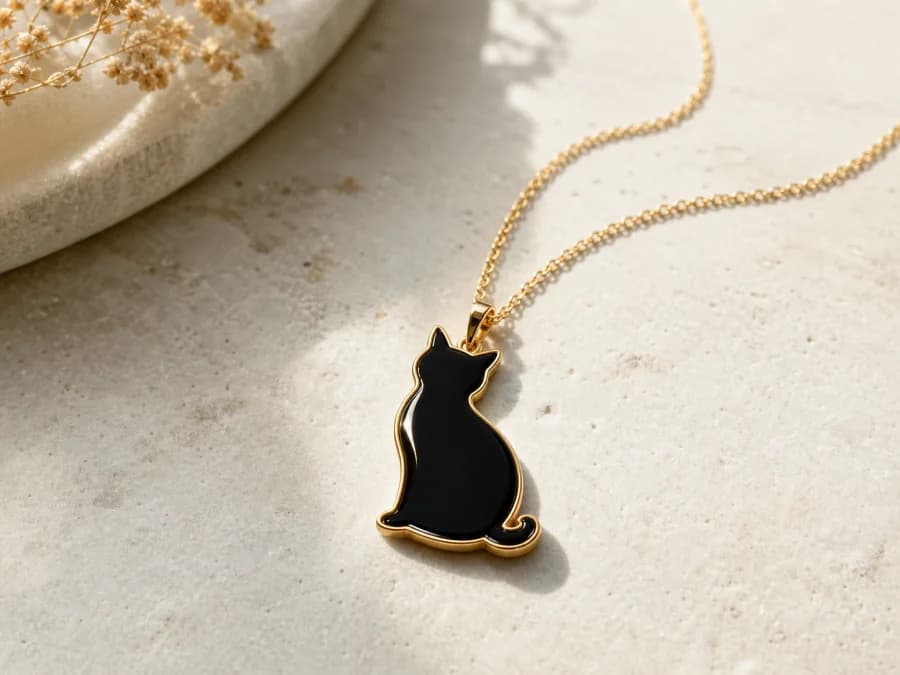
Black Cat Jewelry Guide (Style, Meaning, Gift Timing)
Black cats are the hardest subject to render in a small pendant and the best subject for silhouette work. Here is which styles hold up, what the symbolism actually carries, and the two dates worth planning a gift around.
Cat Mom & Cat Dad Gift Ideas That Aren't Cheap Charms
Most cat-themed gifts are novelty items that get used twice. Here is how to buy something a cat parent keeps — including what to confirm about metal, sizing, and timing before you order anything personalized.
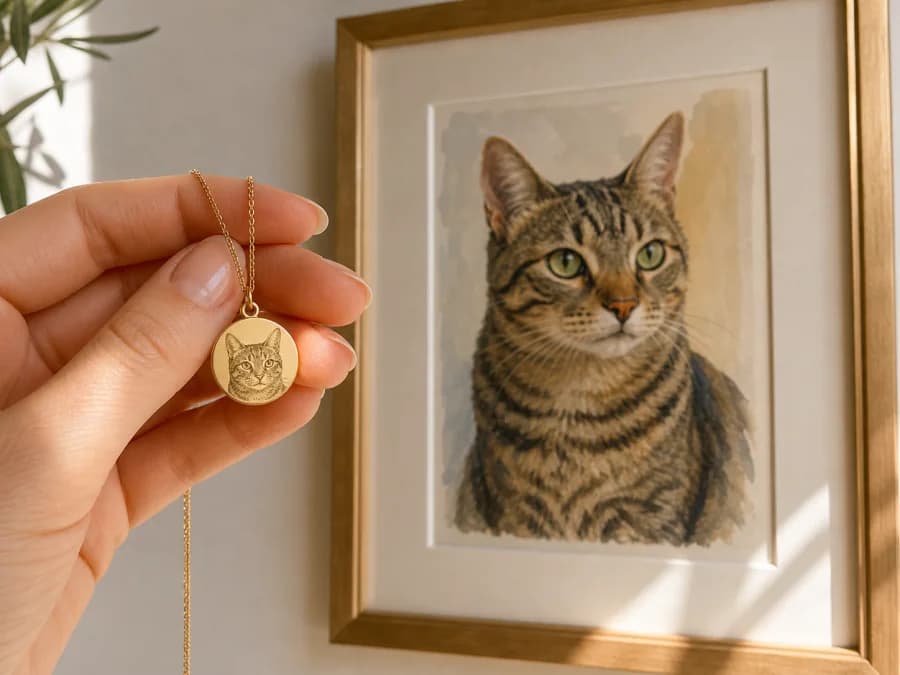
Custom Pet Portrait Jewelry vs Print: What's Worth Buying
Wearable portrait jewelry and framed pet portraits solve different problems. Here is how they compare on likeness, cost, durability, and daily use — and which one to commission first.