Many homes have both children and cats. When a cat bites a child, the goal is to clean the wound quickly, get the right medical advice, and understand what triggered the bite so it does not happen again.
AI Summary
Overview
Treating a cat bite on a child is similar to treating a cat bite on an adult, but children should be evaluated by a doctor sooner.
The riskiest interactions: Using hands to play with the cat, disturbing a sleeping cat, and chasing the cat.
The highest-risk age range: 3 to 7 years old, when children move quickly but cannot yet read cat signals reliably.
The core reason cats bite children: Most cases are preventable.
Pet Owner Story
When my niece was 3 years old, she was lightly bitten on the finger by my cat at my home. It was not a severe bite, but she cried, and my sister immediately wanted to rehome the cat.
Later, we reconstructed what happened: the child had been chasing the cat, the cat ran into a corner with no escape route, and then bit. A cat almost always gives warning signs before biting, but a 3-year-old simply does not know how to recognize them. Ears pinned back, tail swishing quickly, hissing: these signals are obvious to many adults, but to a toddler they practically do not exist.
One adoption-safety rule is worth repeating:
"Use interactive toys, like wand toys and strings. Do not use your hands to play with cats, because that teaches them to bite and claw at hands even when you are not trying to play."
That rule is especially important for children. I spent two weeks teaching my niece three things: if the cat walks away, let it go; do not chase or block the cat; use toys, not hands. We never had another bite incident after that.
Cats and children can absolutely live together, but adults need to create the rules instead of expecting children to figure them out on their own.
After reading multiple TikTok posts from families with babies and cats, I noticed that the most common issue was not "the cat suddenly went crazy." It was usually three more specific problems: the baby moved too fast, the cat had no way out, and older family members wanted the cat sent away because they were worried about fur, scratches, or bites. Some parents shared that when a baby pulled up to stand or waved excitedly, the cat interpreted the fast movement as either play or threat. In cat cafe cases, even if the business posted a liability notice, the operator could still carry primary responsibility after a child was scratched or bitten.
That points to one important truth: the question is not whether you "trust the cat." The question is whether the adults have already prepared the environment, supervision, and rules.
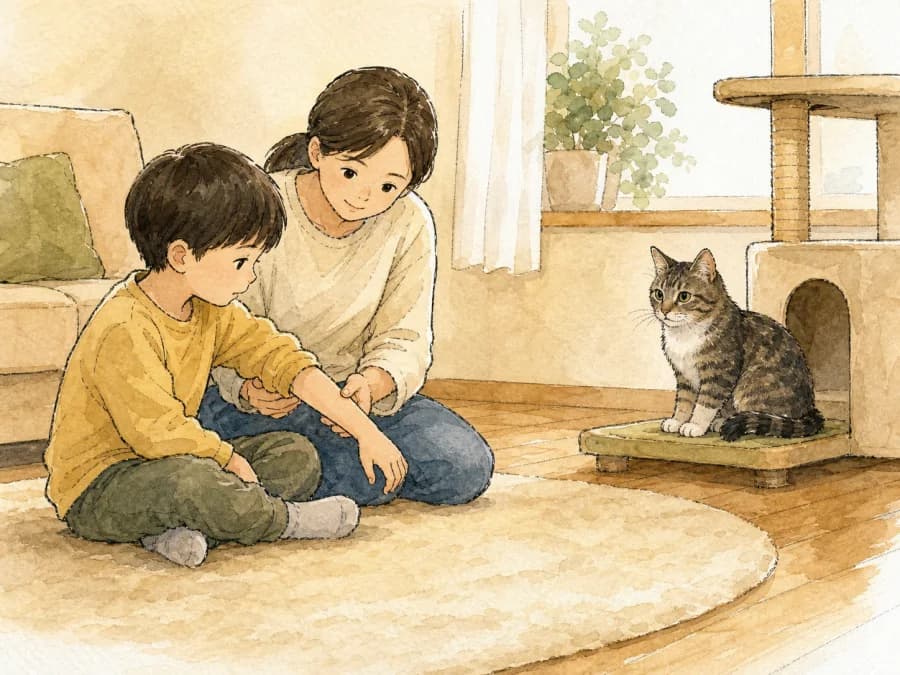
1. If a Cat Bites a Child, Do These Things Immediately
Step One: Rinse the Wound
Rinse the wound right away with running water and soap for at least 15 minutes.
Children usually cry and resist during this step. The parent needs to stay calm and finish the cleaning in a gentle but firm way. You can say, "I know it hurts, but this is important. We will do it together."
Step Two: Disinfect
Apply povidone-iodine or 75% alcohol to the wound. Povidone-iodine is less irritating to skin, so it is often the better first choice if the child resists.
Step Three: Get a Medical Evaluation
If a child is bitten by a cat, it is best to let a doctor evaluate the wound, even if the wound looks small.
Children differ from adults in several ways:
- They may have trouble describing pain or discomfort accurately, which can hide early infection signs.
- Wound infections may develop faster.
- Their immune systems are still developing, so they may not handle certain infections as well as adults.
Let the doctor decide what needs to happen next instead of assuming "it should be fine."
2. Why Did the Cat Bite the Child? There Is Almost Always a Trigger
Many parents instinctively blame the cat first. But when you review what happened, you will usually find that the cat gave signals before biting; the child simply did not know how to read them.
That is a child development issue, not a cat morality issue. Children ages 3 to 7 move quickly, react loudly, and have a hard time controlling excitement. Those are exactly the behaviors most likely to trigger a cat bite.
The Most Common Trigger Scenarios
| Trigger | What it looks like | Why the cat reacts | Adult response |
|---|---|---|---|
| Chasing or cornering | The child follows the cat or blocks its escape route. | A trapped cat may bite defensively when running away is no longer possible. | Create escape routes and teach the child not to chase or block the cat. |
| Disturbing sleep | The child touches or grabs a sleeping cat. | A startled cat may bite automatically before fully waking up. | Make sleeping areas off-limits and let the cat wake naturally. |
| Taking a toy or prey object | The child reaches for a toy, insect, string, or object the cat is focused on. | The cat may treat the child as interference during hunting-style play. | Trade with another toy and have an adult redirect the cat. |
| Playing with hands | The child wiggles fingers or lets the cat chase bare hands. | The cat learns that hands are prey and may bite harder as play escalates. | Use wand toys or toss toys; keep hands out of chase games. |
| Holding or squeezing | The child hugs, lifts, or restrains the cat. | Restricted movement can trigger defensive biting. | Teach gentle petting and let the cat choose contact. |
| Baby movement | A baby pulls up, waves, squeals, or moves suddenly near the cat. | Fast, unpredictable movement can trigger swatting, grabbing, or defensive reactions. | Use barriers, distance, and close adult supervision. |
| Cat needs are neglected | After a baby arrives, the cat gets less play, grooming, cleaning, or attention. | Unused energy and stress can make children look like play targets. | Schedule daily play, keep routines stable, and protect cat-only spaces. |
Use this table to reconstruct what happened before deciding that a bite was random.
3. How to Teach Children to Live Safely With Cats
By Age Group
| Age group | Supervision level | What to teach | What to avoid |
|---|---|---|---|
| Ages 0 to 3 | Full adult supervision for every interaction. | Focus on distance, barriers, and calm routines rather than expecting the child to be gentle. | Never leave babies or toddlers alone with a cat. |
| Ages 3 to 6 | Adult present; do not leave the child and cat alone together. | Teach simple body-language rules: fast tail, pinned ears, hissing, and walking away mean stop. | Do not allow chasing, cornering, hugging, or touching a sleeping cat. |
| Age 6 and older | Gradually more independence, with adult oversight during early play sessions. | Teach cat body language seriously and let the child help with feeding or simple care. | Do not assume maturity equals safe handling; keep rules consistent. |
Age is only a guide. The child's impulse control and the cat's temperament matter more than the birthday.
Teach Five Core Rules
- Stop when the cat says no.
- Do not bother the cat while it eats or sleeps.
- Use toys for games, not hands.
- When the cat wants to leave, let it leave.
- Babies and cats should not be unsupervised.
Rule 1: "When the cat says no, you stop."
Teach children the cat's "no" signals in language they can understand:
- Ears pinned back = "Do not touch me."
- Tail swishing quickly = "I am unhappy."
- Hissing or growling = "Final warning."
Whenever the cat gives these signals, the adult should guide the child back immediately and explain, "The cat is saying no right now. We give it space."
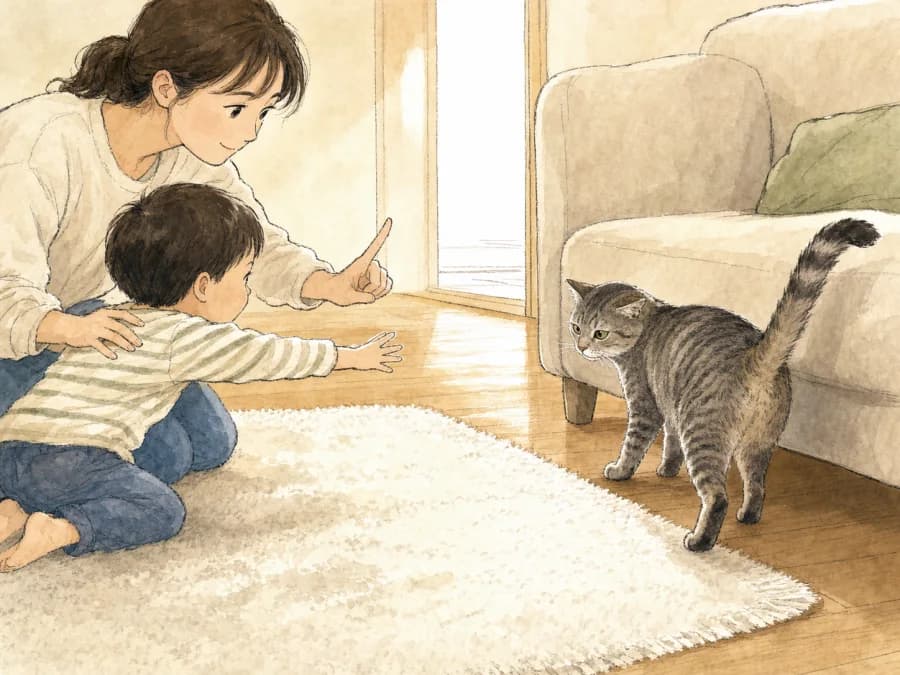
Rule 2: "Do not bother the cat while it eats or sleeps."
This is one of the easiest rules to enforce and one of the most effective. Put a small sticker near the cat's bowl and bed: "When the cat is here, do not bother it."
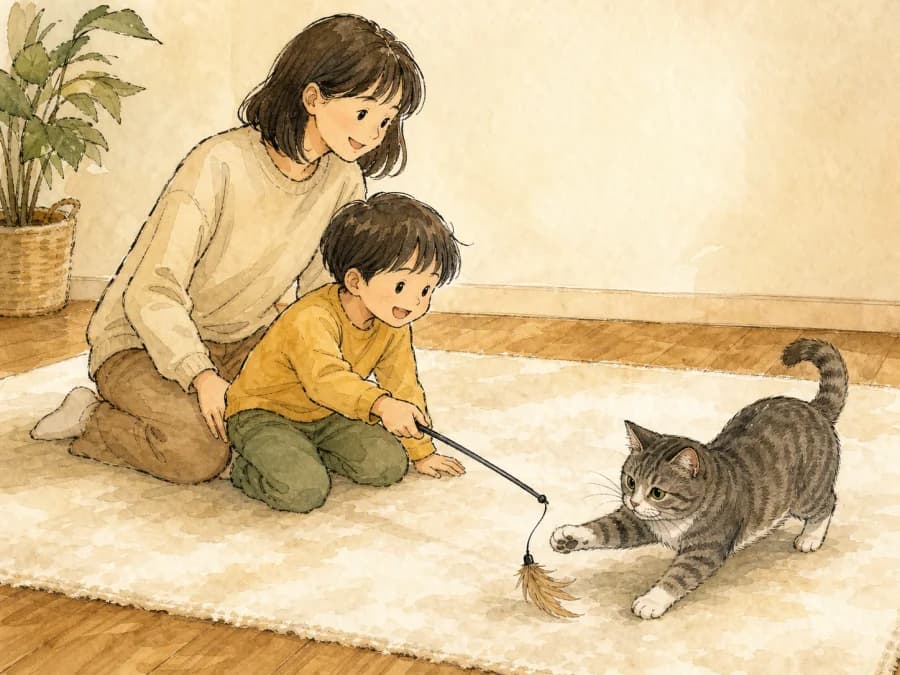
Rule 3: "Use toys for games, not hands."
Give the child one or two dedicated wand toys and be very clear: "This is the cat's toy. Your hand is not the cat's toy."
Older children, especially age 6 and up, can learn how to use a wand toy correctly: move the toy along the floor and do not poke the rod toward the cat.
Rule 4: "When the cat wants to leave, let it leave."
Do not chase the cat, block the cat, or force it down from a high place.
Teach the child: "If the cat walks away, it does not want to play. If it wants to play later, it will come back."
Rule 5: "Babies and cats should not be unsupervised."
No matter how gentle the cat usually is, babies and cats should not be left alone together. In real cases, many scratches or bites are not caused by a cat actively attacking. They happen because the baby suddenly reaches, chases, presses on the tail, or blocks the cat when it is trying to leave. If no adult is present, no one can interrupt the interaction when the cat gives warning signs.
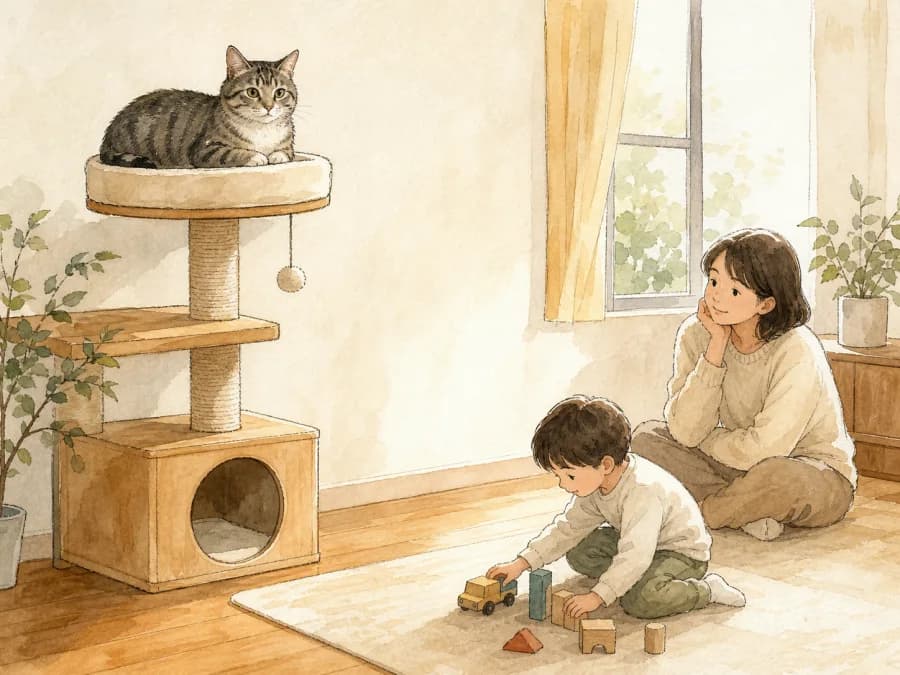
4. Give Your Cat a Safe Zone
In addition to teaching the child, you need to help the cat through the environment.
Why this matters: Cat bites often happen when the cat feels trapped and has nowhere to go. If the cat has enough escape routes and safe spaces, it does not need to use biting to protect itself.
Specific setup ideas:
| Method | Purpose |
|---|---|
| Install a cat door so the cat can enter or leave a specific room | Gives the cat a child-free safe area |
| Place a cat tree in a corner the child cannot easily reach | Height is a safe zone for cats and can reduce defensive aggression |
| Keep the feeding area away from the child's main activity area | Reduces resource-guarding behavior |
| Put the litter box somewhere the child rarely enters | Being disturbed while toileting is a common bite trigger |
5. If the Cat Has Already Bitten the Child Once, What Should You Do Next?
First: Do not punish the cat
Many parents' first reaction is to hit the cat or lock it away. Both make the situation worse. Cats do not understand punishment after the fact. They only associate "being locked away" with "someone came near me," which can make them more defensive and more likely to attack.
Second: Reconstruct what happened
Think through:
- What was the child doing at the time?
- Where was the cat, and what state was it in?
- Were there warning signs before the bite?
Usually, you will find that the event could have been prevented.
Third: Reset the interaction rules
For the next two weeks, all child-cat interactions should happen with an adult present. Actively practice the rule: when the cat says stop, we stop.
Fourth: Let the child rebuild the relationship through feeding
If fear has developed between the child and cat on both sides, the best repair method is to let the child give the cat treats. Once a day, the child places a treat in the palm, and the cat chooses whether to come take it. Do not force contact. Simply build the association: child appears = good things happen.
Key Takeaway
A cat biting a child is almost never "random."
It happens when the child triggers the cat's defensive instinct: cornering, disturbing sleep, or overexcited play. The child is usually not trying to be harmful. They simply do not know the cat's language yet.
The adult's job is to:
- Teach the child the cat's language.
- Give the cat safe space.
- Supervise early interactions consistently.
When those three things are done well, cats and children can absolutely become close companions.
Do not equate "the cat bit the child" with "this cat cannot stay." A more accurate question is: Was there a clear trigger? Does the home have supervision rules? Does the cat have a safe zone? If the answers are no, fix the environment and interaction pattern first. That is usually more responsible than rushing to send the cat away.
References
VCA Animal Hospitals: Play and Predatory Aggression in Cats
Cornell Feline Health Center: Feline Behavior Problems: Aggression
Animal Behavior & Care Writer
Rachel has a background in zoology and animal care volunteering. She writes about cat behavior, enrichment, and the relationship between cats and their everyday environment.
Written by Rachel Breen. Read our Editorial Policy.
FAQ
Frequently asked questions
Free Feeding vs Scheduled Feeding: Which Is Better for Your Cat?
Compare free feeding and scheduled meals, including portions, begging, multi-cat homes, and a gradual transition plan.
ComparisonHow to Calm a Scared Cat: Five Gentle Steps
Help a scared cat feel safer with quiet cover, soft body language, optional calming aids, and a steady routine.
How ToYour Cat Won’t Eat Dry Food? 6 Proven Solutions for Picky Eaters
Learn why cats refuse dry food, how to try gentle feeding changes, and when appetite loss needs veterinary attention.
How ToHow to Stop Your Cat From Shedding (The 3-Month Protocol)
A practical 3-month cat shedding routine: careful Vitamin B cycling, fish oil, daily brushing, and clear supplement safety limits.
How ToHow to Stop Your Dog From Eating Cat Food: A Guide for Multi-Pet Homes
Keep dogs out of cat food with better feeding zones, timing, barriers, and safer multi-pet routines.
How ToHow to Stop Ants and Cockroaches from Stealing Your Cat’s Food
Keep ants and cockroaches away from cat food with safer storage, cleaning, and pest prevention steps.
Why CatsNew on NookPetdia
Latest articles

Black Cat Jewelry Guide (Style, Meaning, Gift Timing)
Black cats are the hardest subject to render in a small pendant and the best subject for silhouette work. Here is which styles hold up, what the symbolism actually carries, and the two dates worth planning a gift around.

Cat Mom & Cat Dad Gift Ideas That Aren't Cheap Charms
Most cat-themed gifts are novelty items that get used twice. Here is how to buy something a cat parent keeps — including what to confirm about metal, sizing, and timing before you order anything personalized.

Custom Pet Portrait Jewelry vs Print: What's Worth Buying
Wearable portrait jewelry and framed pet portraits solve different problems. Here is how they compare on likeness, cost, durability, and daily use — and which one to commission first.